
Most beginner traders focus on finding the perfect entry signal or the hottest stock tip. But here’s what separates professionals from the 90% who lose money: risk management is the real key to survival, with the primary goal not just to make money but to survive market volatility by controlling position sizes, setting stop-losses, and defining risk-per-trade limits. You can have the most accurate chart pattern analysis in the world, but without proper risk management, one bad trade, or worse, one bad week, can wipe out months of progress. This article explains what risk management is, why it matters more than your entry strategy, and how to implement it starting today.
What Is Risk Management?
Risk management in trading is a system of rules and measures used to protect trading capital from severe losses. Think of it as your financial seatbelt; it won’t prevent accidents, but it dramatically increases your chances of survival when things go wrong. The harsh reality? Data from SEBI’s 2023 study showed that a majority of active derivative traders incurred net losses over a defined period, as the market does not reward activity but rewards precision and discipline.
The Core Principles Every Trader Must Follow
- The 1-2% Rule: Your Trading Lifeline
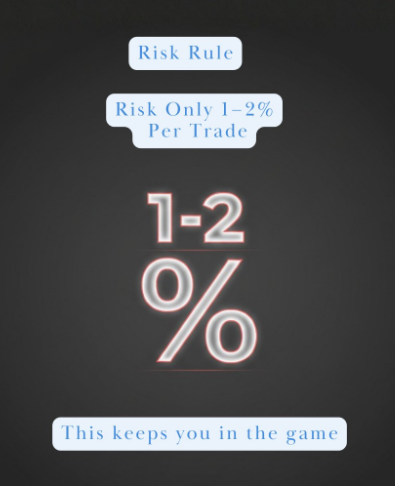
Professional traders stick to 1–2% of total capital per trade as their maximum risk . This isn’t a suggestion,it’s the difference between staying in the game and blowing up your account. Here’s why it works: If you risk 2% per trade, you can survive 50 consecutive losses before your account reaches zero. In reality, even terrible strategies rarely lose 50 times in a row, giving you plenty of room to learn, adapt, and eventually find your edge. If you cannot manage risk with $100, you will not manage it with $10,000, capital size doesn’t fix poor risk management.
2. Stop-Loss Orders: Your Mandatory Insurance Policy
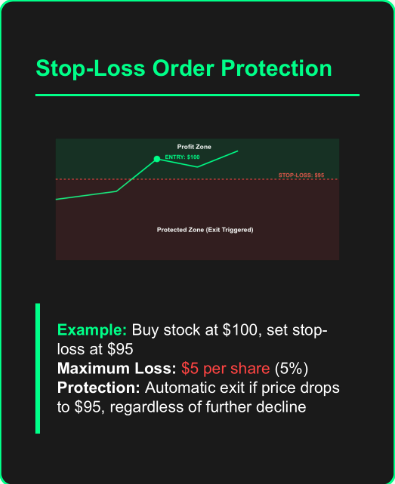
A stop-loss automatically closes a trade once it hits a predetermined loss level, serving as your safety net that limits damage when the market moves against you. Here’s a practical example: You buy a stock at $100 and set your stop-loss at $95. The most you’ll lose is $5 per share, no matter if the stock drops to $50 overnight due to unexpected news.
Critical rule: Smart traders always define their stop-loss before entering a position, not after. Waiting until you’re in the trade invites emotional decision-making when you’re already under pressure.
3. Risk-to-Reward Ratio: The Math That Makes You Money
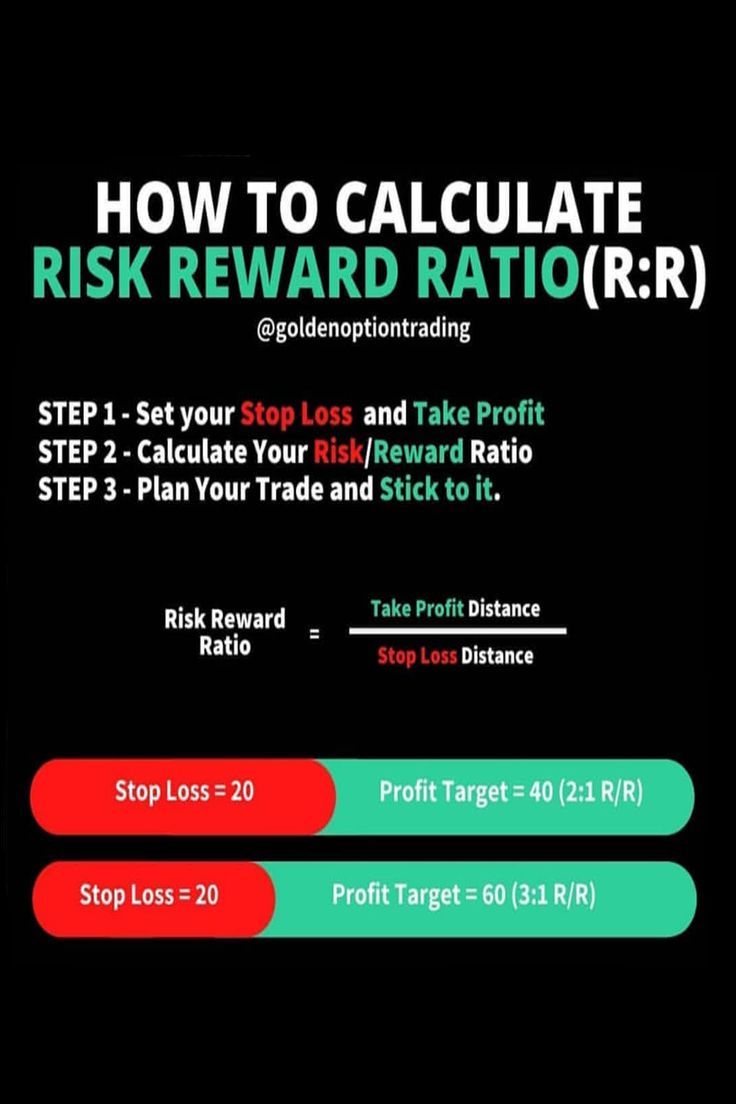
Before placing a trade, compare the potential gain with the potential loss, aiming for a minimum ratio of 2:1—risking $1 to potentially make $2. This math is powerful: Even if you’re only right 50% of the time, a 2:1 reward-to-risk ratio means you’re profitable. Win 5 trades at $200 each ($1,000 profit) while losing 5 trades at $100 each ($500 loss) = $500 net profit despite being wrong half the time.
4. Diversification: Don’t Put All Your Eggs in One Basket
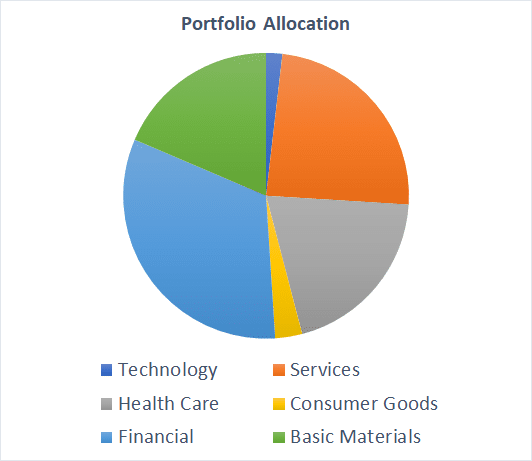
Don’t put all your money into one asset or sector, spread your capital across different instruments like stocks, ETFs, commodities, or currencies to reduce exposure to single-market risks. Even within the stock market, diversify across industries. If tech stocks drop sharply while you also hold energy or consumer holdings, those can balance your portfolio and prevent catastrophic losses.
5. Position Sizing: The Formula That Protects You
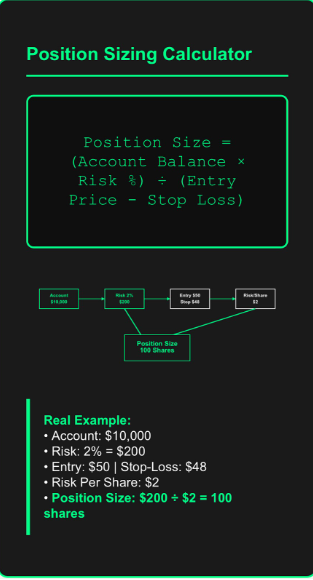
Position sizing determines how many shares to buy based on your account size and risk tolerance. Here’s the basic formula:
Position Size = (Account Balance × Risk %) ÷ (Entry Price - Stop Loss Price)
Example: You have a $10,000 account and want to risk 2% ($200). You’re buying at $50 with a stop-loss at $48 (risk of $2 per share).
Position Size = $200 ÷ $2 = 100 shares
This ensures your maximum loss on this trade is exactly $200, or 2% of your account.
Building Your Personal Risk Management System
Follow these practical steps to design a personal risk management system: Define your maximum risk per trade at 1–2% of total capital, set daily or weekly loss limits so that once you hit the limit you stop trading to avoid emotional decisions.
Daily Loss Limits
Set a maximum daily loss—typically 4-6% of your account. If you hit this limit, walk away. No exceptions. This prevents revenge trading, where emotional decisions compound losses.
Weekly Loss Limits
Consider implementing a weekly loss cap at 8-10% of your account. Some traders have bad weeks. The key is preventing a bad week from becoming a catastrophic month.
Understand and Respect Volatility
Volatility measures how much prices fluctuate, and higher volatility means bigger potential gains and larger risks—adjust your position size based on volatility .
For example, trade smaller positions during earnings announcements or major economic events. A stock that normally moves 2% daily but might swing 10% on earnings day requires 5x smaller position size to maintain the same dollar risk.
Leverage: The Double-Edged Sword
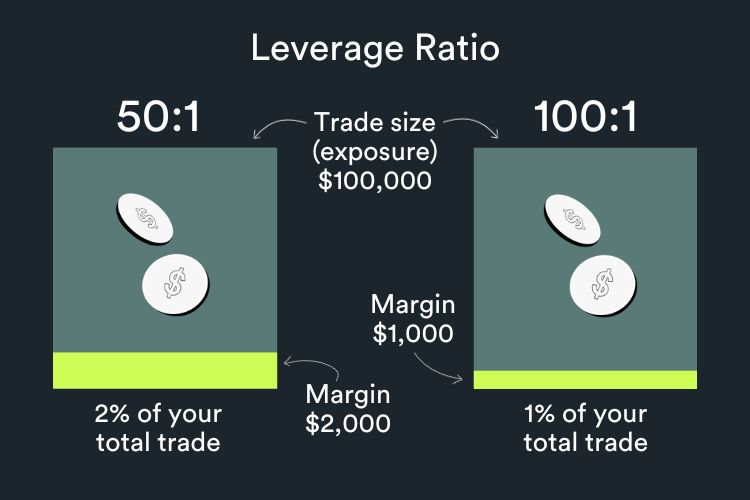
Leverage allows you to trade larger positions with smaller capital, but it amplifies both gains and losses; many traders fail because they use too much leverage without a plan. If you use leverage, always pair it with tight stop-losses. A 2:1 leveraged position with a 5% adverse move equals a 10% loss on your actual capital.
Common Risk Management Mistakes
Common mistakes include chasing losses by trying to catch up after a bad trade, overtrading with too frequent activity that increases risk and commissions, and ignoring risk management by skipping stop-loss orders or exceeding risk tolerance. Never move your stop-loss further away when a trade goes against you. This violates your original risk plan and often turns small losses into devastating ones. More capital does not automatically equal more profit, risk management trumps capital size every time . The trader with $5,000 and excellent risk management will outlast and eventually outperform the trader with $50,000 and poor discipline.
In bear markets, when prices fall, protecting your money is the priority, and beginners should focus on careful risk management and using stop losses .
Implementing Your Plan Starting Today
1. Calculate your maximum risk per trade (1-2% of your account)
2. Before entering any position, determine your stop-loss level
3. Calculate your position size using the formula above
4. Set alerts or use stop-loss orders—never rely on manually monitoring
5. Keep a trading journal tracking your risk on every trade
6. Review weekly: Are you following your rules?
Risk management isn’t sexy. It won’t make for exciting dinner party conversation. But it’s the unglamorous foundation that every successful trader builds upon. The market will always offer another opportunity. Protecting your capital ensures you’re still around to take it. Start treating risk management as your number one priority (not an afterthought) and you’ll join the small percentage of traders who actually survive long enough to become consistently profitable.
References:


Responses