
You’ve spent the past three weeks learning the mechanics of trading: risk management rules, position sizing formulas, and advanced techniques for protecting your capital. You know you should risk 2% per trade, calculate position size based on your stop-loss, and never move your stops. But here’s the brutal truth: Emotional trading is the #1 reason traders lose money, fear, greed, and revenge trading override logic and destroy accounts faster than bad strategies.
This week, we’re tackling the invisible opponent that sabotages even the best-laid plans: your own psychology.
Why Your Brain Wasn’t Built for Trading
Your brain was not designed for trading, it evolved to seek safety, avoid pain, and act quickly to threats, all the opposite of what financial markets require. Think about it: Our ancestors survived by running from saber-toothed tigers and grabbing food when it appeared. Quick reactions meant survival. Hesitation meant death. Your brain still operates on this ancient wiring.
But the stock market rewards the exact opposite behaviors:
∙ Patience over impulsivity
∙ Accepting small losses without panic
∙ Sitting through uncertainty without acting
∙ Letting profits run instead of grabbing them immediately
In 2026, cognitive psychologists have identified a specific “dopamine loop” that keeps traders glued to their screens, every time you click “Buy” or “Sell,” your brain releases a small surge of dopamine, the same chemical released during gambling. Even losing trades provide a neurochemical reward through the uncertainty and “action.” Over time, you stop trading for profit and start trading for the dopamine hit.
The Big Three: Fear, Greed, and FOMO
Let’s break down the emotional traps that destroy more accounts than any chart pattern ever could.
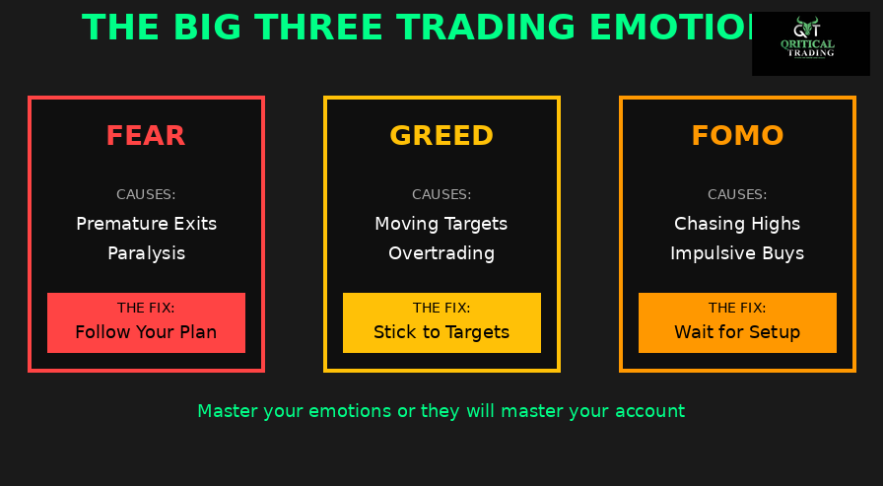
Fear: The Paralysis and Panic Trigger
One of the most common emotions a trader could face while trading financial markets is fear—the fear starts to build up as soon as your positions start to lead to losses, and despite a carefully planned trading strategy, many traders decide to take sudden actions .
Fear manifests in two destructive ways:
- Premature Exits: Closing a trade too early because of the fear of losing the profit gained so far. You planned to hold until $55, but at $52 you panic and sell, then watch it hit $58 without you.
- Paralysis: Fear in trading can be triggered by unexpected market volatility and could cause you to base your decisions on anxious thoughts rather than sound analysis, leading to panic-driven sell-offs or not opening positions at all.
You see your perfect setup. Your checklist says “yes.” But fear whispers “what if you’re wrong?” So you do nothing, then watch the trade work exactly as planned, without you in it.
Greed: The Profit Killer
Greed is one other common emotion accompanying traders—people start trading in the hope of earning money and securing their future, but how does one decide that enough is enough, especially if the market is moving in their favor?
Greed shows up as:
Having the position open for too long, despite it having already achieved the profit hoped for at the time of opening, moving the Take Profit threshold as the market moves in your favor, and over-trading using too much margin in the hope of fast gains or simply trading too much. You planned to sell at $110. Stock hits $110. But greed says “it could go to $120!” You move your target. Then the stock reverses to $102, and you sell in frustration, turning a winner into a loser.
FOMO: The Account Killer
FOMO is the fear of missing out on a big opportunity, it happens when traders see a market move and jump in without analyzing the situation fully, often triggered by seeing others profit from a trade or news of an uptrend. In forex, FOMO manifests as chasing parabolic moves, jumping into a trade after a massive near-vertical price spike hoping it continues, buying at the worst possible price right when early buyers are taking profits.
The Instagram trader posts massive gains. Your group chat is buzzing about a stock up 40% today. You weren’t watching it. Suddenly you feel left out. You buy at the top. It crashes. You lose.
Revenge Trading: The Death Spiral
This is the most dangerous emotional trap of all.
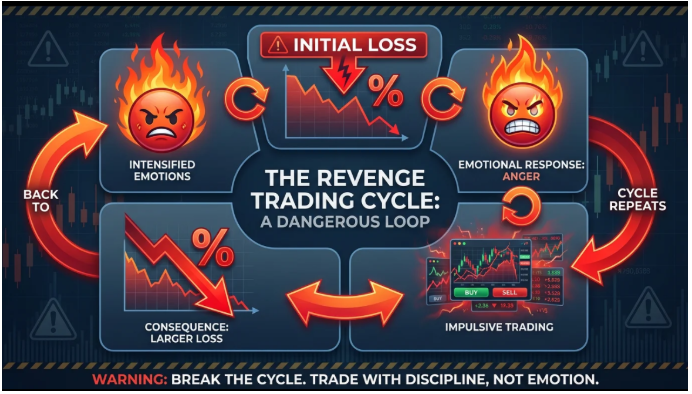
Revenge trading is when you make impulsive trades to recover from a loss, after a bad trade, instead of analyzing what went wrong, you dive back in to make it up, with the goal to “win back” the lost money, but this often leads to more losses. Revenge trading creates a vicious cycle driven by fear of more losses, which actually drives traders to take huge risks to try to recover previous losses quickly, combined with greed about desperately wanting to recover losses fast.
The pattern looks like this:
1. You lose $200 on a trade
2. Ego is bruised. You feel stupid.
3. You immediately jump into another trade—bigger size
4. “I’ll make it back in one trade”
5. You lose $400
6. Now you’re down $600 and desperate
7. You take an even bigger trade
8. Account blown
Revenge trading after you lose $500 leads to immediately jumping back in with a larger position to “win it back.” This is the fastest way to blow an account.
Overtrading: Death by 1,000 Clicks
Overtrading is the act of buying and selling financial assets too frequently, often driven by emotional impulses like boredom, greed, or the desire to recoup losses rather than a logical strategy. After a win, you feel invincible and start seeing setups that aren’t really there, afraid to miss the next winner; after a loss, you revenge trade to make it back, afraid of falling further behind.
Signs you’re overtrading:
∙ Taking trades that don’t meet your criteria
∙ Trading during lunch or after hours “just to see”
∙ Finding reasons to be in the market constantly
∙ Feeling anxious when you have no positions
∙ Checking your account every 5 minutes
One of the most powerful mindset shifts in 2026 is recognizing that sitting in cash is a strategic trade, you are choosing a “0% return” over a potential “-5% loss,” and patience is a form of active risk management.
How to Build Emotional Discipline
Understanding your emotions is step one. Controlling them is step two. Here’s how professionals do it:
1. Name Your Emotions - Finding out what you feel and naming your emotions is the first step to controlling them and applying logical thinking to help put your emotions aside, thinking logically helps you come to rational decisions based on facts rather than feelings.
2. Create a Trading Plan (Your Emotional Fortress)- You can’t predict your profit in 2026, but you can control your behavior every single trading day—focus relentlessly on process, track what you control, build habits that compound. A trading plan is a precise set of rules for entering and exiting trades and should include limits and thresholds for stopping trading after a certain amount of loss—this is the point when you walk away from the keyboard.
Your plan should specify:
∙ Maximum daily loss (e.g., -3% of account = done for the day)
∙ Maximum number of trades per day (e.g., 3 trades maximum)
∙ Required checklist score (e.g., setup must score 8/10 to take)
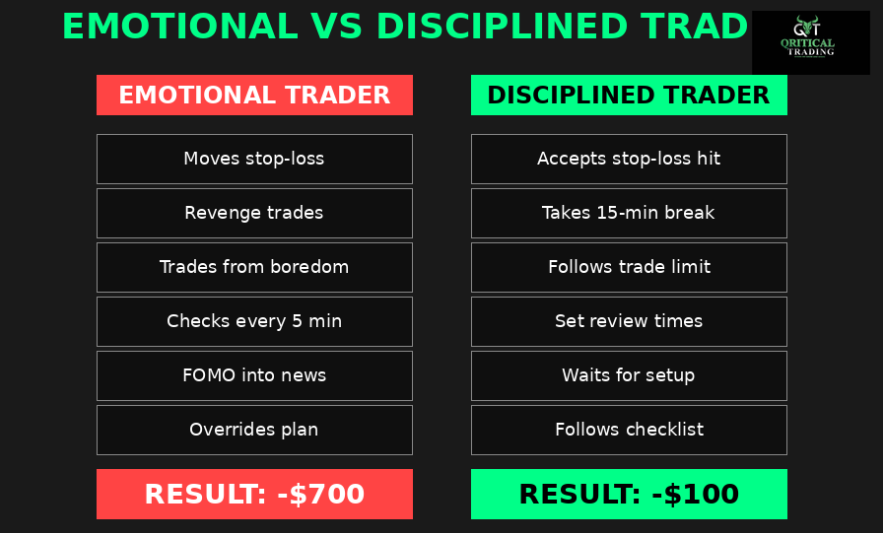
∙ Mandatory break after any loss (e.g., 15 minutes minimum)
Your trading plan isn’t just a document; it’s a non-negotiable contract with yourself, written when you are calm and objective, to be executed without question when the market is chaotic.
3. Use Process Goals, Not Outcome Goals- Process goals focus on actions you control 100%, while outcome goals depend on market conditions, luck, and factors outside your control.
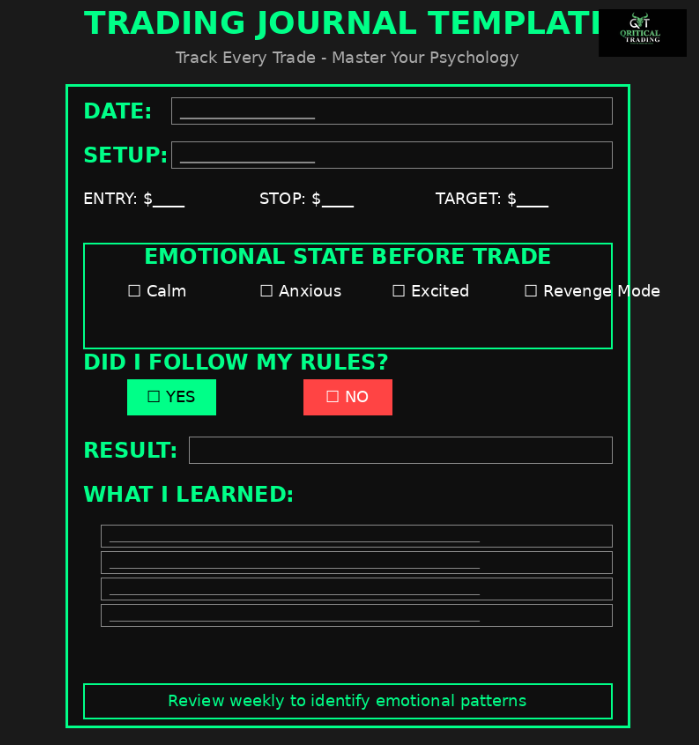
4. Keep a Trading Journal - Keeping a trading journal, following a consistent pre-trade routine, reducing position sizes during losing streaks, and separating your self-worth from your trading results are all practical starting points for building mental resilience.
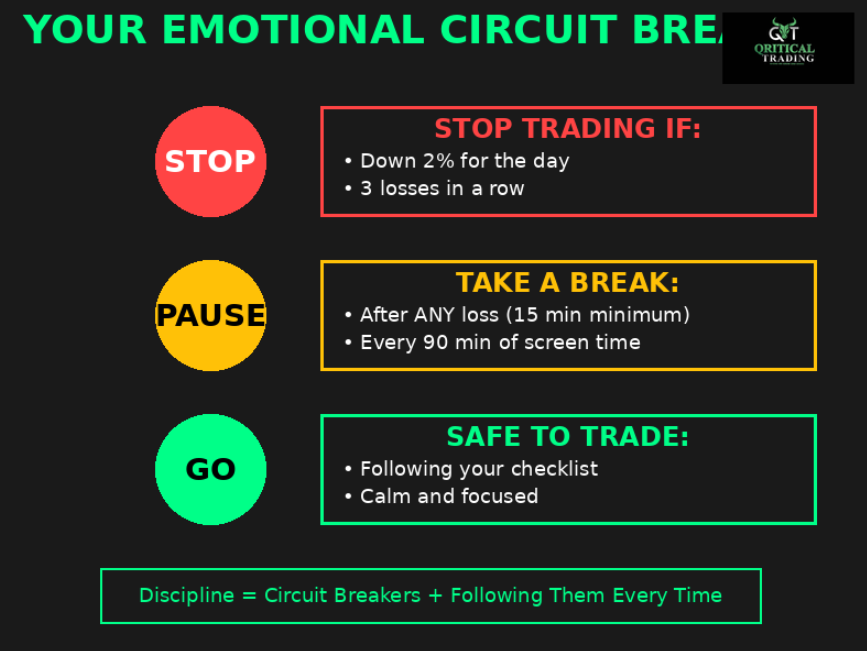
5. Implement Circuit Breakers
Having a trading plan means you will have reasons for entering and exiting trades and rules for dealing with the inevitable losses and periods of drawdowns, if your plan is robust enough, you can execute it without having emotions take over.
Circuit Breaker Rules:
- Daily Loss Limit: Down 2%? Close your platform. Done for today. Non-negotiable.
- Mandatory Breaks: Take a mandatory 15-minute break after any losing trade before considering another entry .
- Three-Strike Rule: Three losses in a row? Stop trading. Review what’s happening. Is it your strategy or your emotions?
- Weekend Review: Never enter Monday without reviewing last week’s trades and emotional state.
6. Manage Your Physical State - Willpower is a limited fuel tank influenced by sleep quality, stress levels, decision fatigue, blood sugar fluctuations, and caffeine/stimulant use—this is emotional bandwidth, and you don’t need more discipline, you need more bandwidth to execute the discipline you already have. Trading while tired, hungry, stressed, or caffeinated is like driving drunk. Your brain can’t make good decisions.
7. Develop Self-Awareness Through Mindfulness - Engage in positive self-talk by consciously replacing negative thought patterns with constructive affirming statements to boost confidence, maintain composure, and minimize the impact of emotional biases in decision-making. Practice mindfulness; when you feel anxiety or greed creeping in, take 60 seconds, close your eyes, take three deep slow breaths; this simple act can reset your nervous system and bring you back to a state of rational calm.
The 48-Hour Rule
After a significant loss (more than 1% of your account), professional traders often implement a 48-hour cool-down period. No trading for two days. This prevents revenge trading and gives your brain time to process the loss without making it worse.
Your Action Plan for This Week
This week, focus on psychology, not profit:
1. Create your trading rules - Write down your daily loss limit, position size rules, and mandatory break times
2. Start a journal - Track every trade and how you felt before/during/after
3. Identify your emotional trigger - Are you prone to FOMO? Revenge trading? Fear?
4. Set one process goal - Example: “I will take a 15-minute break after every loss”
5. Practice naming emotions - Before each trade: “I feel _____”
6. Implement one circuit breaker - Pick a daily loss limit and actually stop when you hit it
Trading psychology matters because markets trigger strong emotional responses—price volatility creates stress, rapid gains create overconfidence, and losses trigger panic or denial; long-term performance often depends less on finding perfect setups and more on consistent execution. You can have the best strategy, perfect risk management formulas, and ideal position sizing but if you can’t control your emotions, none of it matters.The best traders manage emotions instead of reacting to them—market bubbles and crashes perfectly illustrate behavioral finance, where optimism and herd mentality drive valuations far beyond reality, then loss aversion causes panic selling, proving that collective psychology can move markets more than fundamentals.
The good news? Emotional control is a skill you can develop. It takes practice, self-awareness, and systems that prevent your worst impulses from reaching your trading account.
Start today. Your future profitable self will thank you.
References:
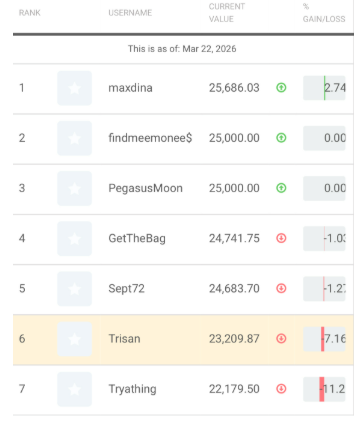
HOW THE SIMULATION IS GOING - join us next month. Moving down to $1000. The goal is to start real trading with $250 in July.

Responses